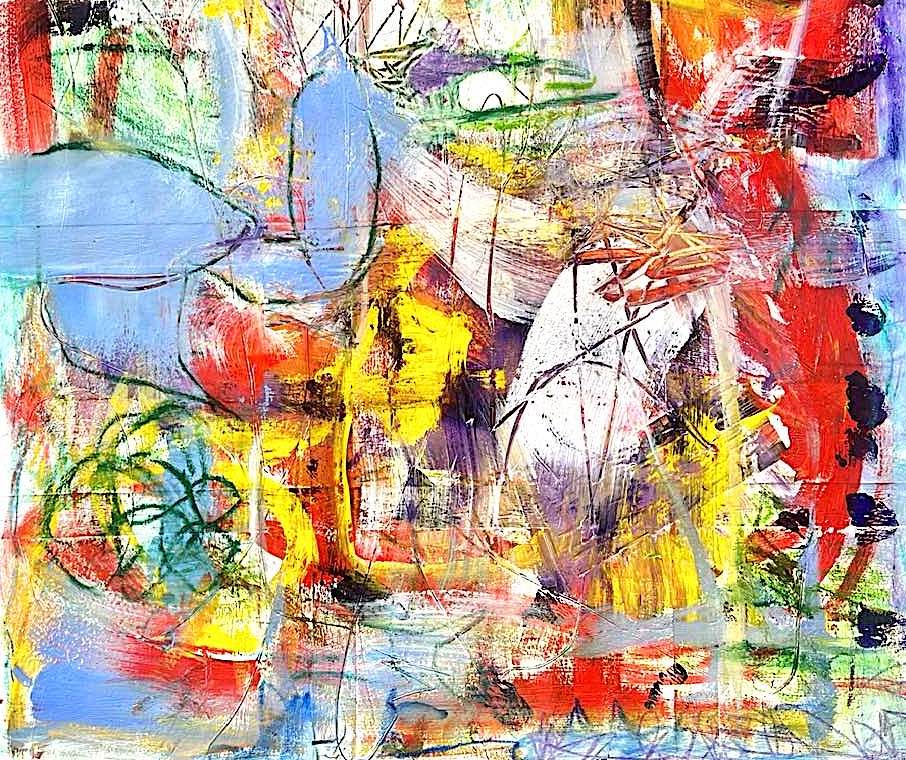
Painting by Pamela Heater
From Tom Dooley, Managing/Fiction
Many thanks to Pamela Heater for brightening things up with her vibrant paintings. Also to Thomas Hubschman for contributing not one but two devastatingly thoughtful and thought-provoking essays for the Salon.
Something strange happened with this issue, and it's probably worth noting, which is only two short stories wound up surviving the selection process to make it into the Fiction section. In the past 30 years, there have been a few issues with only four stories, but two is a new record. This got me curious, like, is this weather or climate change? Turns out, it's both. A hurried glance at the archives shows in the past five years, we've averaged about six stories per issue. The five years before that, about eight. And the five years before, just over nine.
Hard to say why this is happening, though. It might be the larger, decades-long trend in the literary world away from short fiction, with fewer readers wanting to read and fewer writers wanting to write it. It might be a cooling off of the appeal of non-paying, independent and obscure, web-based literary publications like Eclectica to the so-called "emerging writers" we've shone a light on over the years. It might be I'm getting crankier as an editor as I advance in age, though I don't think so because when I go back and reread some of our earlier issues, I'd accept those stories all over again. Whatever the reason(s), while we can probably expect to see more than two stories per issue going forward, the days of regularly packed Fiction sections may be in the past.
Packed is certainly the right descriptor for the Poetry section, though, as it's been every issue since the indomitable Christine Potter took the helm. She is a force, and it's great to see poetry thriving like it is. Big thanks to Marko Fong, who not only continues to contribute amazing essays (not always before we go live&mash;at the time I'm writing this, there's still a "coming soon" disclaimer on the Salon page—but they're always worth waiting for), but this issue he fully took the prose reins and delivered seven solid entries, with Annabel Gregg's "Delayed Gratification" winning Spotlight honors.
Before I sign off, I want to mention Linda Griffin has a short story collection, Reckless Disregard and Other Stories, available for preorder. Ron Currie is not sitting on his laurels with the highly acclaimed The Savage, Noble Death of Babs Dionne. He's already got the prequel, We Will See You Bleed, available for preorder. You can be alerted to the details of these and other publishing triumphs by Eclectica alums by checking out our Facebook group, Eclectica Magazine extended "family."
I also want to mention Azin Neishaboori and Fejiro Okifo both have works looking for editors/agents. Neishaboori's Inscribed with Unsteady Strokes is an 86,000 word, multi-POV contemporary literary fiction about an Iranian-American family whose precariously-balanced lives unravel when a long-held property in Tehran is put up for sale. Okifo has worked her story "The Thing Without a Name," which was the Spotlight winner of the Jan/Feb 2022 issue, into a full-length novel.
It's a turbulent world out there, and it's probably going to get more so in the coming months and maybe years. I urge you to stay safe, keep your loved ones close, and connect with your fellow thinking humans by reading literature of all kinds, including the online variety, to especially include Eclectica Magazine.
From Marko Fong, Nonfiction
I sometimes look at our non-fiction submissions as a kind of online Y Ching, one without the sticks. We read the submissions, take the ones we like, then I—as perhaps the only person who will read them all at once—try to identify some emergent theme. With some issues, the stack of accepted submissions still manages to defy classification or interpretation. This time, however, it felt pretty obvious: they explore the question of "How we keep going?"
Annabel Gregg's "Delayed Gratification" uses the image of a runner who keeps on running to share a story about the physical complexities that sometimes accompany abortion mixing with the too public political controversy surrounding what should be a very private matter. The result is both poignant and funny all at once. It's this issue's Nonfiction and overall Spotlight winner.
Harli Palme's "Definition of a Town: March 2025" is an affecting prose poem about the survival of a place after a natural disaster.
Michael Rosenkrantz describes the cautious pursuit of a relationship after age 65 and surviving cancer in "One Month."
Kate Johnson explores a complex connection to an absent father while visiting a post-Katrina New Orleans in "Resilience in a City of Ghosts."
Carol Runyan's "Chilling" recounts the attempt to maintain a friendship with someone whose life has fallen apart in ways and for reasons not fully understood.
Elaina Wolff's "Kafka and Wartime" is the second installment in a curiously Kafkaesque journey to trace the places where the author's life led him.
David Guaspari rather regularly submits what I'd call absurdist humor pieces that we publish from time to time. "Rowing Over" is an interesting departure for his previous work in that it's more of a memoir and something more emotional: an appreciation of a recently passed friend coupled with the memory of a quintessentially English and quintessentially silly University rowing event. The change in tone took me by surprise in a good way and reminded me that sometimes we change direction a bit, but we find our ways to keep going.
From Christine Potter, Poetry
Every day, things are gettin' worse—The Pioneers, "Time Hard"
I keep bumping into wisdom from one social media warrior or another on how a mere poet-citizen is supposed to deal with her sorrow over the country where she was born imploding. Do I write? Read? Rage? I keep thinking about Auden's "Musee Des Beaux Arts," an ekphrastic poem about Breughel's Icarus. In the painting, Icarus, his wax wings melted, plunges into the sea—and no one really notices. Suffering, Auden says, "takes place while someone else is eating or opening a window." True dat, but does it help you to think that way? It sure doesn't help me.
So here. Here's the Spring 2026 poetry section from Eclectica. But first, maybe YouTube or Spotify that cheery little reggae song from The Pioneers. Not Auden, but something to listen to while you read. Our Eclectican poets this time may not be Auden, either, but I swear they'll help you out. We have a first rate selection this issue.
It's healthy serving of poems, full of strength, light—and honest acknowledgement that "time so hard." There are a number of nostalgic poems. I'm especially fond of Mary Jo Robinson-Jamison's "Begin As A Child" with its piano lesson metaphor. Rachel Dacus sent us another packet of her work, and it turns out she's actually nostalgic for pandemic days! And she makes an solid case for it. Juan Pablo Mobili notes in his excellent "Faint Signals" that "sometimes the scent of lemons from a tree I grew up climbing is the only balm."
I don't think sieving through past sweetness is a bad thing. That's how you put fuel in your tank. Otherwise… well otherwise, it's just too much.
J. Alan Nelson hits the nail right on the head with his "The Poet Tries Not To Become a Rooster:"
the poem wants something quieter,
something that doesn't end up looking
like a barnyard animal having a stroke,
wings flapping, beak open, red comb flopping
like a drunk's tie at last call.
That poem, by the way, deals out the f-bombs and repeats the word "hate"— and yet is not a bit didactic. I love it.
Penelope Moffet gets called to "write a poem on air" by a crow whose "feathers lift into dishevelment, sink back to smoothness, lift again." (And yes, I'm jealous that I didn't write those lines.) Joe Mills gives us a meditation on being from Indiana, and watching a neighbor do silly-looking martial arts, which he finds mildly annoying but also endearing. Another good, funny poem about neighbors is Bruce Morton's "This is just to say" riff about his neighbor's garbage. (If there is one thing this time in America is teaching me, it's the importance of neighborly relations.)
Oh—and there's a bear in Morton's poem, so that's plus points.
Novelist and book store owner Richard Fulco makes his Eclectica poetry debut pondering a 24-year-old Revolutionary War hero who died not in battle, but of "a short but excruciating fit of illness" and concludes "My only promise is to make promises." It's a darn good poem.
Some of my favorite pieces this issue were written by Sara Quinn Rivara, who gives us these drop-dead opening lines:
When I was fourteen at a Confirmation retreat run by the Society
of the Divine Word, I lit the altar cloth on fire on purpose.
We also have a generous serving of Word Challenge poems. The words were sandal, translucent, dusk, and obsidian. So of course, there are some volcano poems—one from Shaun R. Pankoski, who has lived in Volcano, Hawaii. Madronna Holden took up the challenge, describing obsidian as "this stone black as night/and still as the stars/after dusk has had its way with them."
Nancy Sobanik, who is a Registered Nurse as well as a poet, takes us to the NICU with the Challenge words, and manages a Rothko allusion! And Juan Mobili brings us back to the Current Situation, "and the future is as uncertain as bread being left to fend for itself, in an unattended oven."
Juan's right—but this poetry section is somehow neither a downer nor someone turning away from the fall of Icarus. I hope you find it soothing. However you are feeling about the slog we are all on, it's good to have company.
Word Challenge Words for summer are tiresome, bulletin, amber, and nap. Give ‘em a spin. Keep recording this time in poems, friends. It will be over one day, and folks will need to know how we managed to get through it all. See you in the summertime!