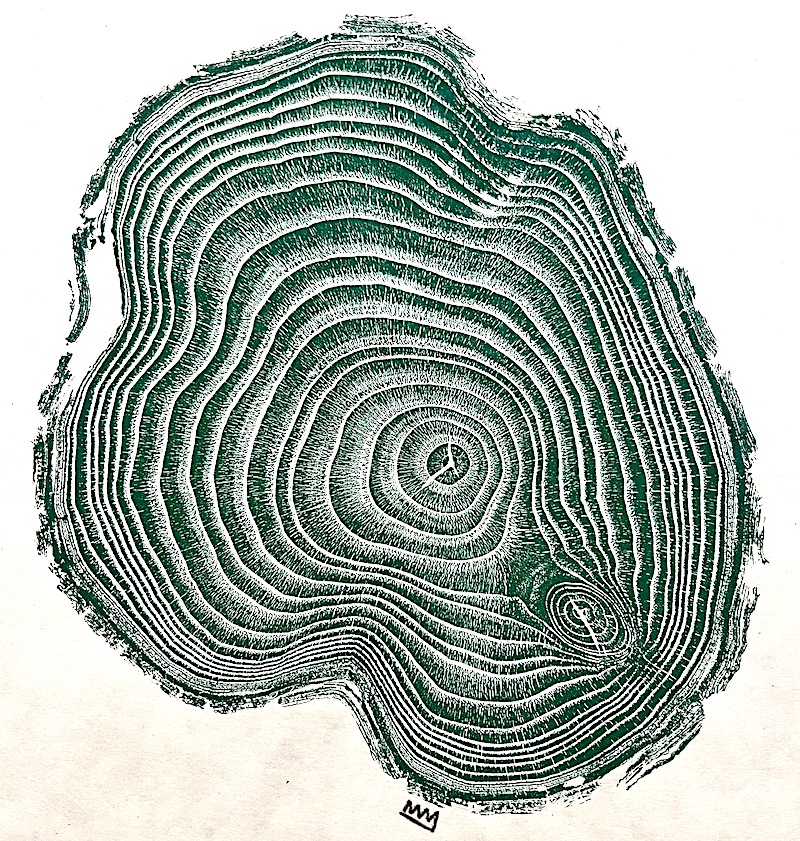
Tree art by Stephen King
The Russian's head was completely bald, his scalp furrowed by deep wrinkles that began well above his forehead and rolled down to his eyebrows like waves to the shore. His eyebrows were thick, black and bristly, contrasting sharply with his imperial mustache and goatee, which were snow white and fastidiously trimmed and oiled. He regarded the world through humorless eyes, dark and unblinking. He looked like a man who had come to expect little from life.
Effie Perine, standing slightly behind and to the left of him, said: "Mr. Spade, this is Mr. Kemidov. He wishes to see you."
Spade rose, bowing from his desk, and indicated the armchair beside it. His face was impassive, but his eyes flashed at the mention of the Russian's name.
Kemidov maneuvered his ample buttocks into the chair, hugging a gladstone bag to his gut with great clumsy arms. "General Kemidov," he said with a heavy accent.
Spade nodded as if he had expected that and asked: "And what can I do for you, General?"
Kemidov responded by heaving the bag onto Spade's desk. It landed with a thud. "You will know of this, I believe."
Spade reached for the bag and pulled it toward him. His eyes glowed under raised brows. He undid the brass catches and drew out the foot-high figure of a black bird. He whistled softly. "The dingus."
Kemidov grunted disgust. "No, not the dingus, as you call it. Look at the bottom."
Spade turned the statue over to examine the base. A nick had been made in the smooth enamel coating, exposing the soft grey sheen of lead beneath. "Another fake. But you were supposed to have the original—a golden falcon encrusted with jewels, made as a gift for Emperor Charles by crusader knights."
The general laughed a harsh syllable, "Ha!" and pulled out a box of cigarettes.
Spade set the statue down. He retrieved a pigskin and nickel lighter from the desk and leaned over to ignite the older man's tobacco.
Kemidov inhaled cigarette-smoke and blew it at the ceiling in a long pale cloud. "I will tell you a story in three parts. The first is how I came to have the statue. I am Russian. White Russian. I led forces in South Russia, fighting the Bolsheviks. We captured Crimea, Ukraine and a large part of southern Russia, reaching Moscow by October 1919."
Spade nodded politely, taking a packet of brown papers and a sack of Bull Durham tobacco from his desk to begin construction of his own cigarette.
The Russian screwed up his eyes and continued: "But then we were pushed back. I and many of my compatriots were forced into exile, sailing from Crimea to Constantinople, where we settled in a suburb that came to be known as a Russian conclave. Naturally, many of us were short on funds, and just as naturally, many were forced to sell jewelry and other valuables to eat. I was more fortunate than most, however, and when a fellow army officer proffered a curious black figurine of a falcon, I agreed to the transaction—not so much because I wanted the figurine, but because I wanted to aid my brother officer in his time of need. And, in fact, I agreed to sell it back to him for the same price should he restore his finances."
Spade licked his cigarette, sealed it, and asked: "Do you think he knew what it was?" as he reached for his lighter.
"Later, I wondered this, too. I have no idea, but the point is moot. Shortly after he sold the bird to me, he was found dead in an alley, throat slit from ear to ear."
Spade lit his cigarette and blew smoke down the front of his vest. "If he didn't know, apparently someone else did."
"Maybe. But this is the first part of my story. I acquired the bird as a favor, having no intrinsic interest in figurine itself. It is clear?"
"As well water."
The Russian moistened his lips with his tongue. "Now the second part. A few months ago, I met a man, a very fat man, by the name of Casper Gutman. He approached me in a café catering to Russian émigrés. Somehow, he had heard that I owned the falcon and wished to buy it from me."
"Was this before or after your friend was murdered?"
The Russian bunched his lips and tilted his head to one side. "It was after. I told this Gutman I had no interest in selling—I still had some notion that my friend's family might wish to redeem it—but the fat man was very insistent. In the face of my refusals, he raised his offer not once, or twice, but three times. In the end, the amount he suggested was closer to what one would pay for a good diamond than the sum one would associate with an only mildly interesting curio."
Spade frowned. "And you didn't wonder why it was worth so much to him?"
A wry smile twisted the Russian's mouth. "He said he had a fetish for curios like these—that he had made it his mission in life to collect them. He was such an outré character, I halfway believed him. And then, I confess that I was distracted from further consideration of the matter by the arrival of a character of an altogether different sort."
"A character with blue eyes and red hair?"
"Exactly! She called herself Wonderly and she appeared at the same café with a dark fellow she said was her brother, although it was it was hard to see the family resemblance."
"Did the brother have a name?"
"Floyd."
"What happened then?"
The Russian's jaw sagged. He blinked vacant eyes. "I made a fool of myself. Me, who almost captured Moscow, and would have done so but for the treachery of Makhno, allowed a mere girl to wrap me around her finger. I became completely obsessed and invited her and her brother to stay in my home. I plied her with gifts—jewelry, clothing, perfume—and begged her to marry me. She gave me to understand that she would, subject to her parents' approval, and requested that I write a letter making my case. I stayed up all night drafting the text and when I went to her room the next morning to share it, she and her brother were gone."
Spade's yellowish eyes glittered between narrowed lids. "And the bird? Had they taken the black bird?"
Kemidov puffed on his cigarette and then flicked ash into a crystal receptacle on the desk. "At the time, I did not associate them with the figurine or with Gutman. Having no particular interest in the bird except as a kind of collateral, I did not keep it on display but simply stored it in a trunk at the foot of my bed. I had occasion to open the trunk a week or so after they left, and the bird was still there. And that is part two of my story. Gutman offered to buy the black bird; I turned him down. Wonderly and her brother appeared, stayed in my home and then left abruptly. Clear?"
"Also clear. And part three?"
"Much of part three you already know. I read many papers, a number from overseas. One such paper is the San Franciso Call as San Francisco is a place with a significant Russian émigré population. Imagine my surprise when I read of several murders, including that of your partner, a man named Floyd Thursby and Gutman himself, along with the arrest of a woman named Brigid O'Shaughnessy, who sometimes went by the alias Wonderly, all of whom were tied up in an affair involving a golden artifact of untold value made by the Order of the Hospital of St. John of Jerusalem for Emperor Charles V as tribute for their use of Malta. I immediately retrieved my figurine from the chest and used a pen knife to scrape a portion of the enamel from the base. As you have seen, I did not find gold, only lead."
Spade gripped the arms of his chair, cigarette tucked in the corner of his mouth. "But Gutman and the others were convinced you made a copy for O'Shaughnessy to take, while retaining the original for yourself. Now you're saying there were two copies—one that O'Shaughnessy caused to be shipped here and one that you brought today. What happened to the original? Or was there never an original?"
"This is what I will pay you to discover. But I will tell you this—I realized after I retrieved the figurine that it was subtly different than I remembered. I had remembered areas on the surface that protruded. Under the enamel, these protrusions had sharply delineated edges and facets, such as you'd find on a cut stone. But if you examine the figurine in front of you, the protrusions lack definition. They are mere lumps."
Spade stared through the Russian and spoke as if using speech to arrange his thoughts: "It's possible O'Shaughnessy left you a duplicate and took the original, but she was as surprised as anyone when the figurine in San Francisco turned out to be fake. The same goes for Cairo, who was working with O'Shaughnessy until she double-crossed him. Captain Jacobi, master of La Paloma, had the opportunity to make a switch, but he died bringing the bird to me. He wouldn't have risked it for a fake." His stare became more focused. "It doesn't wash. There's a piece of the puzzle we're missing, most likely a person involved of whom we've no knowledge."
Kemidov brought a hand over his mouth and nodded gravely. "You have a better grasp of events in San Francisco, but, yes, that makes sense. So, I put it to you—will you undertake to find the bird for me? I will pay you two hundred dollars up front and a thousand more if you recover it."
Spade grinned wolfishly. "Yes, that seems to be the going rate. You understand that it's possible—even likely—that the real falcon isn't in San Francisco. That the place you should be looking is Constantinople or elsewhere in Asia or Europe?"
The Russian placed two hundred-dollar bills on the desk. "Then at least for my money I can eliminate San Francisco."
Spade stubbed out his cigarette and reached over to take the bills. He stood and offered his hand to the Russian. "Luck to both of us."
Spade stepped off a street-car on Geary near Leavenworth and walked half a block to the Geary Inn Hotel. He went through the miniscule lobby to the desk and asked a square-chinned man with pomaded hair to speak to the hotel-detective.
"We don't have one," said the square-chinned man.
"Then let me speak to the manager."
The desk clerk went away, and presently a door by the side of the reception window opened and a sleek man with dark hair and a moustache appeared. He said: "You wish to speak with me?"
Spade nodded. "A guest of yours was killed, a Mr. Floyd Thursby. Shot four times in the back—just outside the hotel."
The manager pursed his lips and swallowed. "That is so. An unfortunate incident that had nothing to do with the hotel. May I ask what business it is of yours?"
"I'm Spade. My partner was killed that night by the same gang."
The dark man looked at Spade and nodded thoughtfully. "So I understand."
"The police—Lieutenant Dundy and Detective-sergeant Polhaus—would have questioned the staff, searched the dead man's room. Did they leave anything behind? Belonging to the dead man, I mean."
The manager drew his head back. "That's not something—"
Spade leaned forward, the v shape of his mouth pulled taut over the v of his jutting chin. "Look, this business isn't finished, in spite of what the cops think. If you want to avoid further mentions of the hotel in newspaper stories, you'll play ball."
"And exactly how will letting you examine Mr. Thursby's possessions keep the hotel out of the newspapers?"
"I'm looking for a link to other gang members. Gang members the police haven't caught. Now, do you still have anything of Thursby's or not?"
The manager looked down. "Mr. Thursby had a valise with clothing and other personal items. The police didn't take it, and no family members have claimed it."
"Let's see it, then."
The manager clasped his hands behind his neck. "All right," he said at last. "Follow me."
He led Spade through a small office to a door that opened on a storeroom. He took a scarred cowhide suitcase from a shelf and brought it to a library table where he placed it on its side. "This is it."
Spade's thick fingers undid the catches and sorted through the contents with deliberate care. Shirts, socks, a union suit and a new package of handkerchiefs were examined and set to one side. He opened a box of thirty-eight cartridges and took out a round, grunting while he held it to the light. "The brother of one of these got my partner."
"You have my condolences," said the manager.
Spade made no reply to that and set the bullets aside. He reached into a side pocket of the suitcase and drew out a matchbox and a stack of paper. The matchbox was bright red with the words Shanghai Low, 532 Grant Avenue, San Francisco printed in a typeface meant to mimic the brush strokes of Chinese characters. The uppermost paper from the stack was folded into quarters, and when unfolded was revealed to be a receipt or bill written in a foreign language. Numbers written on the receipt indicated two of something had been ordered, but the price for the item was given in a foreign currency, so its cost was unclear.
The remaining papers in the stack were all copies of a wanted poster from Hongkong printed in English and Chinese. The wanted individual was named Huang Xiaolin, alias "Big Ears," and the picture seemed to corroborate the nom de guerre. A lumpy-faced individual with protruding ears and fleshy lips, Xiaolin appeared to be in his early thirties and was pictured in a silk shirt with a mandarin collar.
Spade folded one of the posters into quarters and put it and the receipt into his jacket pocket. "I'll hang on to these for now. Thanks for your help."
A puzzled look spread over the manager's features. "I can't see what help it's been, but you are welcome." He hesitated. "And you'll keep the house out of any future scandal?"
"I'll do my level best."
Spade went back to the lobby and out the front door. As he crossed the threshold, a bullet kissed a hole in the door-frame inches from his nose. Another ventilated the crown of his hat. He fell back inside.
Effie Perine held Spade's hat, wriggling a finger through the hole as she stood by his desk. "It's a miracle you weren't killed. Did you see who it was?"
"I was too busy trying to bite the floor," he said from his swivel-chair. "I have a pretty good idea, though." He cocked an eyebrow at the girl.
She frowned at him. "Samuel Spade! This isn't a game. Who then?"
"Polhaus came by to sweep up the glass and comfort the living. He let slip that Wilmer Cook escaped from jail."
"The boy who was working for Gutman?"
Spade reached for his tobacco and papers. "Yeah, the gunsel. But he killed his boss in the end, and before that, he let Floyd Thursby have it right in front of that selfsame hotel." Spade finished rolling his cigarette and chuckled.
"What's funny?"
"I had just finished assuring the hotel manager that I would keep his joint out of the papers. He'll be the lead story now."
Effie Perine sighed and reached for the pigskin lighter. She flicked it under Spade's cigarette. "I knew that Russian was trouble. I never should have let him in the office."
Spade leaned back to draw on his cigarette. "We've got to make rent somehow," he said as he exhaled smoke.
"What will you do next?"
He pulled out the papers he had taken from the hotel and held out the receipt. "It's as much what you'll do. Thursby had this in his suitcase. I think it's a bill of sale for two lead copies of the falcon, written in Turkish. Can you get your cousin the professor at Berkeley to ask one of his egghead buddies to confirm that?"
"I could do that," she said, curiosity replacing her previous scolding tone. "What would it mean?"
"It would mean that we would need to give Mr. Floyd Thursby a lot more credit than we have. That he didn't show O'Shaughnessy the blind loyalty that everyone said he did. Instead of being crossed by her, he crossed her. He contrived to have O'Shaughnessy end up with one fake, either by substituting it after she stole the real one from the Russian or by taking the real one directly from the Russian and leaving the copy for her to steal. Then he left a second fake in the Russian's trunk so he wouldn't tumble to the theft until well after they were gone, if ever."
Color rose in the girl's cheeks. "What did he do with the real one?"
Spade plucked a shred of tobacco from his lower lip and smiled up at her. "I can't say for certain, but if I were Thursby and I were dippy enough to stick with O'Shaughnessy after taking it, I might do as she did and find someone on La Paloma to transport it from Hongkong to San Francisco before jumping on the faster boat with her."
Spade ate a dinner of broiled sturgeon steak with mushroom sauce at Tadich Grill in Clay Street. He walked north down Clay when he was finished and crossed the Embarcadero to go to a pier near the Ferry Building. After shouting to a sailor on the deck of freighter docked there, he went up the gangway and was directed to a cabin below the bridge.
A swarthy man wearing a double-breasted blue jacket and rough woolen cap rose from a cramped desk by a bulkhead as Spade entered. He said: "If you're here for the harbor master, we already spoke. He's going to let us stay berthed another two days."
"I'm not from the harbor master. I'm a detective. I found Captain Jacobi."
The man slumped back into his chair and slammed an account book on the desk closed. "Oh, that business."
"You the first mate?"
"Yeah."
"Where does La Paloma go after two days?"
The first mate sighed and rubbed his face with both hands. "The shipyards. The fire was largely contained in the cargo hold, but the crew quarters were damaged."
"Did most of the crew go ashore then?"
The first mate gave Spade a piercing look. "Why?"
"This business isn't done. The punk that set the fire is still on the loose and I think someone else on board was involved with Jacobi."
"I wouldn't know about that."
"Did any of the crew quit or go missing after you got here?"
"We're a tramp steamer. No set schedule. People come and go at each port of call. It's not exactly a lifelong career."
Spade moved his shoulders impatiently and reached into his coat pocket. He drew out the wanted poster he had taken from Thursby's suitcase and refolded it so the text was hidden. "Know this guy?"
The first mate sat up straight and blinked. "That's our cook—or was."
"He got off here then?"
"Sure. He joined us in Hongkong and most of his pay was passage to San Francisco. Made a great chop suey."
"Did he say where he was going?"
The first mate laughed. "To wash-ee the clothes or chop-ee the suey. What else?"
"Thanks," grumbled Spade and went out the way he had come.
Two yellow taxicabs were at the stand in front of the Ferry Building. Spade got into the first and directed it to Shanghai Low restaurant in Grant Avenue. The maître d' there was a short man with horn-rimmed glasses and a jagged part in his hair like a bolt of lightning.
Spade held out the photo of the cook from La Paloma and said: "This guy work here?"
The maître d' made a bridge with his hands. "I couldn't say."
"Couldn't say or won't say?"
"I don't recognize him."
Spade passed over a card. "This is me—I'm private. The guy I'm looking for is named Huang Xiaolin. He's a cook. I'm not trying to deport him. I just need to talk."
The maître d' returned the card, shaking his head. "I can't help you, Mr. Spade. I know nothing of the man."
A group of five came in behind Spade, and the maître d' left the podium to escort them through an archway to the dining room. An instant later, a busboy in silk pajamas and a silk cap materialized from behind the arch. He said: "You looking for Xiaolin Huang?"
"Yeah, Mr. Xiaolin."
"You pay?"
Spade held out two silver dollars. "I pay."
The busboy nodded and pocketed the money. "Try number 47 Sun Louie Sun Hong."
Spade frowned. "You mean Spofford Alley?"
"Yeah, 47 Spofford," said the busboy and slipped back behind the arch.
Spade left the restaurant and walked up Grant Avenue to Clay Street, where he went left for half a block until he came to Spofford. The alley was barely a dozen feet wide. Number 47 was marked by dented brass numerals on a dark red door at the far end of a brick building that also housed a butcher and an herb shop. Spade knocked.
When no one answered after two more attempts, he reached for the knob. It turned in his hand. The room he walked into was tiny and cramped. A mattress with a rough cotton blanket lay on the floor in one corner and a red lacquer chest in the other. A washbasin and a closed door stood between. On the floor in the middle of the room were a wooden bucket, rags, and a hammer and chisel. Light came from a bare bulb in the ceiling.
Spade walked over to the mattress and tugged on the blanket. The black hair of a Chinese man peeped out. Spade yanked the blanket off entirely.
The man lay spread-eagle on the mattress, an angry red hole weeping blood at his temple. His eyes were wide open, and when Spade knelt to hold the flame of his lighter close to his pupils, they failed to react. Spade snapped off his lighter and searched the dead man's pockets. He found nothing.
He began to stand, but suddenly bent forward, squatting by the man's clenched fist. He pried the fingers open, and a ruby the size of a peach pit spilled out. Spade twitched his upper lip over his left eyetooth. He shoved the ruby into the watch pocket of his vest, not bothering to examine it further.
He stood and walked over to the bucket. The liquid inside was inky black and an odor of turpentine wafted from it. Spade coughed and was reaching for his handkerchief when the door at the back of the room flew open.
Wilmer Cook rushed through, a heavy automatic pistol in one hand, and a rag-swaddled parcel clutched under his arm with the other. He fired at Spade as he went by, the slug passing inches from the back of Spade's head. Spade tumbled forward, and Cook slammed through the exterior door and out into the street.
By the time Spade regained his feet and charged out onto Spofford Alley, Cook was flagging a taxicab at the intersection with Clay. Spade sprinted to catch him, but Cook was pulling the door closed on an accelerating Checker Cab by the time Spade reached him.
Spade dove into traffic to flag a cab of his own, ordering the startled chauffeur to follow the other machine.
"What's the rumpus?" asked the hack-driver.
"Dummy up and drive," growled Spade.
Cook's machine continued North on Clay, barreling through the intersection at Montgomery just as the light turned red. Spade's driver couldn't—or wouldn't—follow. Spade cursed vehemently under his breath.
The next time they saw Cook's cab, it was pulling away from the Ferry Building with Cook nowhere in sight. Spade threw too much many to his driver and rushed to a ticket booth. The Oakland ferry was leaving soonest—was due to leave in minutes, in fact. Spade paid the fare and ran up the gangway moments before it was stowed, and then the boat left the slip.
The deck was deserted. Spade went inside, joining a crowd of nearly a hundred sitting on benches and milling around the bar. Spade walked around the perimeter, scanning the crowd, his blond Satan's face stiff and expressionless as he searched. When he had completely circumnavigated the cabin, he cursed his luck and went outside once more.
A heavy fog, wet and impenetrable, now lay over the boat and the water. The moaning, evenly spaced eruptions of the Alacatraz Island horn seemed to come from all sides. Spade paced along the railing, hugging his coat to his chest as he assayed the deck.
A slap of shoe leather on wet steel sounded between moans of the foghorn. Spade turned to find Wilmer Cook charging at full tilt, stiff right arm aimed at Spade's chest, apparently intent on toppling him into the sea.
Spade bent backward over the railing as the smaller man's body slammed into his. The package Cook had been carrying hit the deck with a deep thud. Spade twisted sideways as Cook's hands came up to grab his throat. He reached down to take Cook by his belt and hefted him up and over the railing.
Cook's yell was swallowed by the waves, his body visible only briefly in the water as a dark, churning blur. Spade turned back from the rail and lunged for the package. As the boat heaved on the swell, the package rolled past his outstretched fingers and into the drink. With the briefest flash of gold in the wake of the boat, it was gone.
Effie Perine was sitting in Spade's chair reading a newspaper when he entered his office at two o'clock the next day.
He said: "Afternoon, angel."
She pointed to an article on the front page. "It says here they found Wilmer Cook's body by Hyde Street Pier."
Spade tossed his hat on the rack and leaned a hip against the desk. His face was wan, the lines running from both sides of his nose to his mouth were etched deeper, but his eyes were clear. "Yeah. Dundy had me under the hot lights until morning, but he gave me the news when he released me."
Effie Perine's brown eyes gleamed. "Do you have the ruby?"
Spade grinned at her and said: "I checked it at the Ferry Building after I called you last night. I retrieved it once I finished with the cops... but I ended up giving it to the Russian."
She sighed. "I guess you had to."
"I didn't have to, but otherwise Kemidov would never have believed my story. He still has his doubts. He insisted I go with him to Samuels Jewelers to have the stone checked out."
"And?"
"The color is what they call pigeon-blood red, the deepest, most desirable color there is. Twenty-six carats. They said they'd never seen anything like it."
"How thrilling! Now tell me about the golden falcon. What did it look like?"
"I never really saw it. I can't say for certain if Cook or Xiaolin actually had it. All I know is Xiaolin used a bucket of turpentine to remove black enamel from something, and next the bucket, he had a hammer and chisel, as might be used to prize out a gem from its setting."
Effie Perine leaned forward to put her elbows on the desk, resting her chin between her palms. "And Kemidov? What will he do now?"
Spade chuckled. "He says he's going to drag the bay. That's a fool's errand—it must be three-hundred feet deep where the bundle went over. But he did give us this." He handed her an envelope.
Effie Perine's nimble fingers ran over the currency inside. "Five-hundred dollars!" She jumped up. "I'll take it to the bank before they close."
She opened the door to the outer office but turned back just before she stepped through. "Oh, I almost forgot," she said in a more circumspect tone. "There's a note on your desk."
"About?"
"A Miss Rhea Gutman stopped by."
Spade raised his eyebrows. "Gutman's daughter?"
"That's right. She wants to hire you."