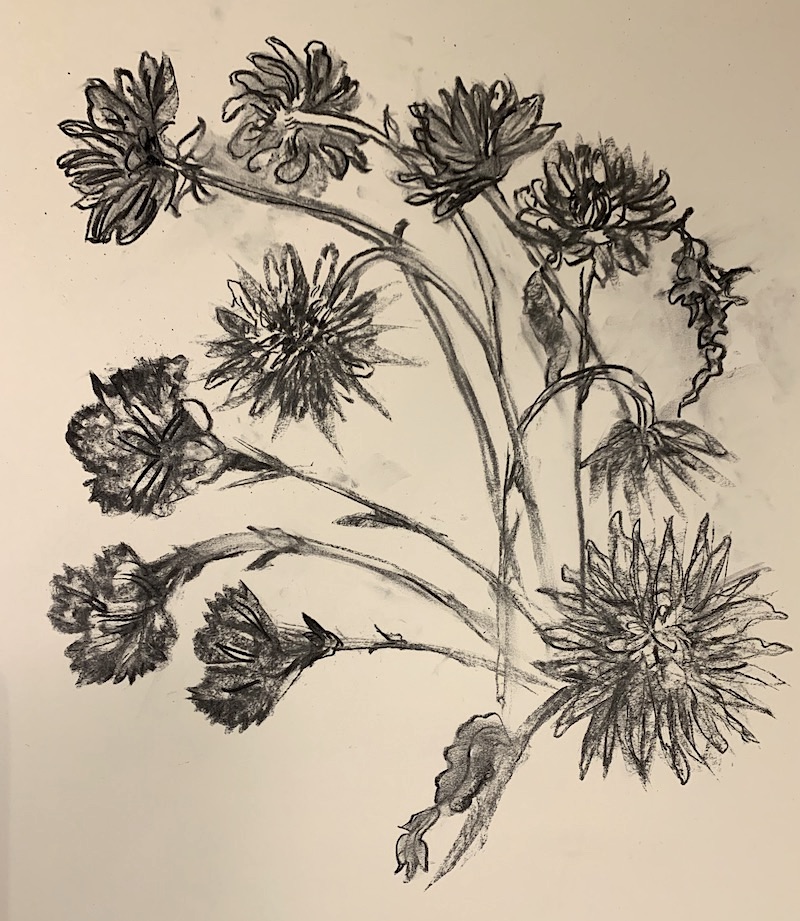
Painting by Elaine Brown Folgar
Officially it was 42 degrees on President's day in Raleigh, but wind, damp, and other things made it feel colder. Most of the last two months, we've lived through a real life version of the eternal winter in The Chronicles of Narnia after the white witch seizes power. The blizzard of news about airline safety, consumer protection, emergency readiness, nuclear safeguards, Gaza, Ukraine, immigration, foreign aid, and federally-funded research has made for a different kind of climate change. Even as the oceans warm and the poles melt, America's becoming a colder, more heartless place. If Aslan's anywhere around, he's doing an excellent job of making his return doubtful. His last known address was in Nazareth, but maybe he's 90 miles south in some tunnel in Gaza. Is he a hostage or hostage taker? These days, who knows if some Aslan will return to save us as he did in Narnia? Shouldn't I at least be getting some Turkish Delight out of all this? Instead, the good stuff's about to get tariffed unless the Turks rename it "America's Delight."
I was on my way to a resistance rally. To my disappointment, downtown Raleigh was unusually quiet, so quiet I found parking on the street. While President's Day isn't a state holiday in North Carolina, Federal workers (whatever's left of them) still had the day off, though public schools were in session. Three blocks from the state capitol, the rally site, the sidewalks were mostly empty. Many of those braving the cold appeared to be actual street people. Was that one of them rebadging a black GMC Denali as a Tesla McKinley? Mckinley was a great President if you happen to think raising tariffs, getting us into a war started by the late 19th century's version of Fox News, and claiming a series of colonies are the markers of American greatness. Some think McKinley's actual signature achievement might have been picking Theodore Roosevelt as his running mate after his first Vice-President, Garret Hobart, died suddenly in 1899. Bottom line, I worried I'd driven 20-plus-miles to go to the wrong place at the wrong time. I'd done this sort of thing more than once.
Writerly discipline tells me I should take the whole Mckinley riff out, but it helps me segue into a more personal matter also impacting my last couple months. Back in December, my wife made me clear out the boxes lining the back wall of our garage. Most of the boxes weren't precisely ours. When we moved ten years ago, my mother came with us, and we wound up with her letters, photos, travel souvenirs. Basically, Mom kept everything in boxes she never looked at or opened. My mother also died in 2018. One of the buried items turned out to be a two-page, typed letter from the headmaster of my high school.
I don't think this was something the headmaster, a nice enough man, routinely sent to parents of a student who wasn't in overt trouble, and I'm not sure what prompted it, though I suspect my parents wanted to understand why they'd spent all this money on their "bright" son who appeared to try hard enough, and he wasn't headed to Harvard or Yale. The headmaster acknowledged I was "very bright" (whatever that might mean), then explained faculty had repeatedly pointed out I was consistently disorganized, started things I didn't finish, didn't always follow directions or assignments, and seemed careless about details... even scattered. He also noted I seemed to have a fascination with injustice but wasn't being sufficiently scholarly about it. In addition, he wrote I was very shy and maybe had been traumatized at some point.
I guess you wouldn't send someone like that to Harvard or Yale. (I know. First world problems.) I suspect some like me got in anyway, though, just not me. The letter implied I had the intellectual capacity but was somehow too lazy or unmotivated to organize myself and justify my family's investment in my future.
Had I seen the letter? Did I know about it? I don't really know. I do know reading it 52 years later upset me. The whole college admissions thing wasn't that big a deal in retrospect. I did eventually graduate from Stanford, a top-ten law school, and later got a masters from Stanford's Graduate School of Education. The letter did seem to come from someone who appeared not to like or respect me much. To be honest, I don't know that I'd ever given him much reason to do either. After reading it once, I ripped the letter into multiple pieces, then stopped clearing out the garage for a couple days. For three weeks, I couldn't stop thinking about it. My stomach and bones still seem to feel it in some way.
I probably don't need to tell you the headmaster's 1972 letter matched up shockingly precisely to the DSM-5-TR's description of symptoms for ADHD inattentive type. ADD first made it into the DSM in 1980 in Version III. Prior to that, it was called "hyperkinetic disorder," something aligning more closely with the hyperactive version of ADHD. Fwiw, the inattentive or decaffeinated variety of ADHD is much harder to diagnose and didn't make it into our understanding of the "disorder" until fairly recently. If others characterized my lack of executive function as a character flaw instead of a sign of neuro-divergence, they likely didn't know any better. I'm pretty sure neuro-divergent (a modern way of suggesting we're more weird than damaged) wasn't even part of the language back then. Had the school instead shown me different strategies for getting organized, breaking down tasks, and holding myself accountable over time, I'm not sure it would have made that much difference. Much of the pain of having ADHD comes from knowing what you're supposed to do but somehow not knowing how to either start or sustain it.
I was upset because I've spent most of my adult life with a severe case of Inattentive ADHD, never seriously attended to it, and–now headed into my 70s–don't exactly have much time left to benefit from fixing it or to do what I can to help address a politically polarized country in which both sides appear addicted to alternating between distraction and outrage. Instead, I was walking through downtown on a very cold day looking for a rally that I might have mis-located or mis-calendared in my misguided attempt to "do something."
I should mention that 28 years ago, I did seek help for ADHD through a therapist who informed me there was no real way to diagnose it, then offered to prescribe me Ritalin. I took Ritalin for a few months, but there was no followup. Even though it helped some (my subjective take), I didn't continue out of fear of either getting addicted or the belief that my will should be sufficient to overcome what I still saw as my own character flaws. A few years later I sought help for depression, something co-morbid with ADHD. At the time, no one suggested a connection between the two. Strangely, I was very popular within my depression group. Apparently, ADHD folk can be pretty good at being both empathetic and unexpectedly funny. It also helped I'd never contemplated suicide.
Consider this personal example. There are people like my wife who know to keep a "to do" list.There are people like me who have to be reminded to make the list, need instruction at times about how to be specific enough in writing things down, then need reminders to actually check the list periodically. At its worst, I might make the list, then not know where to find it two days later. I don't blame others–whether in 1972 or 2025–for interpreting that as either willful laziness or stupidity. After all, I've spent most of the last 50 years blaming myself for those shortcomings. During that time, I got very good at finding ways to distract myself from the problem, which I'd summarize as a consistent mismatch between my stated intentions and my achievements. I'd also mention that in my close-to-70 years of displaying very overt symptoms of Inattentive ADHD, no one's actually pulled me aside and suggested the possibility to me. On a recent group trip, I booked myself into the same bed and breakfast twice. I laughed about it at the time, but it also haunted me–yet another sign of my repeated incompetence at a routine task.
Back to the President's Day rally in Raleigh on a day technically not President's Day in North Carolina. I was definitely relieved and happy to find a few hundred people assembled in front of the State Capitol. It was just that I'd shown up for the wrong rally. No, I'm not talking about turning up at the capitol in the company of guys in white bedsheets and neo-Nazis doing Elon Musk salutes as cybertrucks with gun racks and Confederate flags circled the block honking their horns in solidarity. Based on the number of signs about the importance of counting votes and how Jefferson Griffin was distorting democracy, I'd landed at a Riggs-Griffin protest instead of the "Not my President" anti-Trump-Musk rally I'd meant to attend. At least, this was hardly the sort of rally that was going to culminate in the state capitol police getting assaulted.
Meanwhile, I may not have been the only one who showed up at the wrong rally. The majority of the pre-printed signs were about the North Carolina Supreme Court ongoing election dispute, but there were still enough "Doge Sucks," "Trump 2024 = Project 2025," and "Putin's Puppet" handmade signs to suggest others might have been there to protest something less North Carolina-specific. In any case, I was perfectly happy to support the notion that counting the ballots of people who clearly had the right to vote makes more sense than disallowing them because the board of elections somehow left a box blank. The sensible thing to do is to let the voters with the missing information cure whatever the issue might be with their paperwork. After all, they likely had no idea anything was missing at the time they cast their ballot. Many had voted legally in previous elections. Instead, Jefferson Griffin, the Republican candidate, wants to invalidate the votes of well-intentioned and likely perfectly eligible voters because the board of elections omitted some checkboxes on one percent of the ballots cast and those voters happen to live in parts of the state that voted against him. I guess when you lose two recounts by 700-plus votes, why not find some other way to challenge the will of the people after the fact? This sort of thing clearly worked for someone else, at least ultimately. Even if Griffin loses in court, he can continue to claim he never lost the 2024 election.
I should point out that the court case isn't Griffin vs. Riggs; it's actually Griffin vs. State Board of Elections. Is it because of my ADHD that I sympathize with the State Board of Elections? People make mistakes of omission. When they do, should it deprive 60,000 other people of their most fundamental political right? To paraphrase our current President, I prefer judges who support democracy over bureaucracy. Ironically, it's the bureaucrats who happen to agree with me.
My attending the wrong rally wasn't the fault of my having Inattentive ADHD. After the election, a Reddit poster going by the name "Evolved Fungi" (how do you gender that?) proposed resisting the bombing run of Trump executive orders by mounting 50 protest rallies in 50 state capitols on a single day, hence "50501." I didn't want to dismiss the potential of an anonymous Reddit poster to make something happen. Consider another anonymous, Internet-based presence: Satoshi Nakamoto started out with a paper on a listserv, turned it into Bitcoin, which blockchained itself into a total market value of 1.7 trillion dollars, more or less the GDP of South Korea, the 14th largest economy in the world, or four and a half times Elon Musk's individual net worth. Even today, no one appears to know who Satoshi Nakamoto is or even if he's a real person. Satoshi could well be an early product of AI. Crypto currency is the creation of a Crypto Identity, yet people now take it seriously as real money. It's abiogenesis for capitalists. I imagine whoever or whatever Evolved Fungi is may have decided if Satoshi Nakamoto could do it, they could do the same for an effective protest movement.
Can an anonymous Internet post evolve into the 1963 March on Washington, Tienanmen, or Arab Spring: mass events that at minimum seized the world's attention? I want to believe it's still possible. Thousands of people cumulatively did show up in most every state capitol on February 5, 2025, not overwhelming but certainly promising. There was even media coverage, though not at the level often much smaller Trump rallies received in 2024. President's Day in Raleigh was arguably less promising.
I had intended to go to a 50501 rally scheduled for noon at the capitol. I had the right time and the right place, just the wrong rally. It turned out Common Cause had set up its permitted pro-Riggs pro-Democracy rally for exactly the same time and place. The online notices for the 50501 rally, sometimes called "No Kings" protests, didn't mention that due to Common Causes's previously permitted and scheduled rally, 50501 changed the time of their regular "noon" rally to 3:00 PM. It was, at least, held at the same actual time as the "noon" ones in Sacramento, Salem, and Olympia, even if it wasn't noon local time on the East Coast. Before I drove to Raleigh, I'd checked the time and place of the rally and actually gotten it right.
It was several days later—after I started writing this article—when I discovered two rallies happened at the state capitol that afternoon. A local website had pictures of a President's Day rally at the capitol, looking much smaller than the one I attended. It appeared the rally goers were confined to the sidewalks around the capitol, I suspect because they didn't have a permit for that time. On the same webpage, I also found photos of the better-attended Riggs rally, the one I attended. Would it have made more strategic sense to stage a single rally with maybe 600 people instead of 450 people at noon that day? After all, there was considerable overlap between the people wanting to attend the two events. But how do you coordinate with a disembodied entity?
To be more precise, the 50501 webmaster (or whoever did the 3:00 PM rally) did include an option to "reserve" your place at the "noon" rally. I remember being puzzled at the time because when I attempted to "sign in," it returned a message saying "fully subscribed." I did wonder at the time why anyone organizing a protest rally would ever send a message saying a rally was "full." I suspect now it had something to do with trying to correct the time of the rally to accommodate the Riggs-Democracy event and the vagaries of coding Internet-based forms.
It struck me that whoever was updating the websites for progressive protests in North Carolina might share more than my political sentiments. Years ago when were looking for help for our son who had a traumatic brain injury (TBI), my wife contacted a local group run by a woman who clearly had TBI herself. Ultimately, we got frustrated because she couldn't give us accurate information about when they met or how to participate. Obviously, I have no idea whether the person or persons who update the 50501 information for the various North Carolina protest groups have ADHD. I even suspect it's probably more a matter of lacking the resources to get it all coordinated than some cabal of neuro-divergents taking on the wrong tasks. I also appreciate whatever time and effort they've invested in getting the information out there. I suspect it's also the result of 50501's attempt to stay decentralized and possibly harder to target, a la Bitcoin. To be fair, I did get to a rally I wanted to attend, albeit the wrong one.
Whatever the particulars of two President's Day rallies in Raleigh, I, as a very old person with poorly addressed Inattentive ADHD, look at the up-to-now attempts to organize resistance to the Trump-Musk-Project 2025 Coup and I feel like I'm looking in the mirror. If those trying to organize resistance and speak with one voice don't individually have ADHD, the movement, as a whole, sometimes appears to have it collectively. While we make fun of right wing gaffes like the Four Seasons Total Landscaping press conference or gasp at the chaos of January 6, the truth is the other side managed to organize a genuinely effective protest effort. Yes, they cheated, lied, and broke all known norms of civil behavior to do it, but at a fundamental level, they've been coherent, cumulative, and tragically effective.
So why did the mainstream media continue to cover some surprisingly small Trump rallies in 2024, yet it doesn't do the same for progressive rallies in 2025? To be fair, there was a camera crew from one of the local network affiliates at the Riggs Common Cause rally, but just one. Beyond the concern media ownership is naturally in the hands of the insanely wealthy, there are probably more reasons for this than individual people showing up for rallies. I don't claim to have looked closely, but I've since kept looking for where and when to protest. If there's any kind of grand conspiracy on the left, it's clearly not very well coordinated. Some of it is paranoia. Are we being watched? Is someone monitoring all our postings? Are there provocateurs at the rallies? Is the rally actually a set up either for sabotage or information gathering? In the meantime, right wing events appear to get word of time and place out to the media pretty skillfully, or at least noticed by anyone within "earshot," at one point literally so.
The fears of plots to discredit the rallies have some merit. Earl Caldwell, a black New York Times reporter who was covering the Black Panthers, was unsuccessfully recruited by the FBI to serve as an informant against the Panthers. The government then turned around and tried to force Caldwell to reveal his sources within the Panther party. The Supreme Court ultimately rejected the argument that journalistic privilege prevented the state from compelling Caldwell to defy the subpoena. Shades of Clarence Thomas and Samuel Alito, newly appointed Justice Rehnquist who had played a role in the Justice Department's policy of subpoenaing journalists to reveal their sources, didn't recuse himself from the 1972 case. If you think there was a good old days at the Department of Injustice prior to Pam Bondi, you might be disappointed. Under J. Edgar Hoover the FBI at least had to pretend they didn't do this sort of thing. Half a century later, Kash Patel is more likely to brag about it.
I have a little different ADHD-based theory. While the physical basis for ADHD—if there happens to be one—remains mostly elusive and mysterious, research suggests individuals with ADHD suffer from a dopamine shortage. The neurotransmitter dopamine doesn't get to the right parts of the brain in the right amounts. To grossly oversimplify, dopamine gets messages to the reward and regulations centers of the brain. My wife likes keeping a to do list and actually does the tasks on the list at least partly because dopamine in an appropriately small quantity gets to the reward center of her brain and she gets a little bump of satisfaction out of it. When I try to keep that sort of list, the dopamine doesn't necessarily get there, at least not in the right amounts. I don't feel any sense of satisfaction about doing the groundwork for "getting things done." Instead, I look for other ways to feel "good," but my brain doesn't exactly know how to recognize them. Ultimately, my ADHD self has trouble getting big tasks done because it gets either bored or frustrated laying the groundwork, and thus seldom gets to the big dopamine hit from seeing the light at the end of the tunnel. Fwiw, I can concentrate and focus extraordinarily well at times; I just don't have much of a knack for making myself do it when I need to or others want me to.
In the last decade, I've noticed the right has a pronounced tendency to pat itself on the back for pretty much anything, even when it's actually a disaster like letting a million Americans die in the name of the fundamental right to infect your fellow citizens while taking equine deworming medication. These days, dopamine usually gets mentioned in connection with drug addiction. Back when everyone was jogging, it was credited with runners' high. Before that, it was the treatment of choice for Parkinson's and Schizophrenia. If you've observed Trump rallies, there's a clear addictive quality to all that chanting about hateful stuff. You get the dopamine hit, and you not only can't stop, you start craving even more. No one does a better job of self-congratulation than Trump himself, though Elon Musk appears to be seriously challenging for the title of Doge of Dopamine in the midst of all the other drugs he apparently ingests on a regular basis while zoning out on video games. Dopamine abuse or overdoses have their dangers, too; a loss of sensitivity as users increasingly confuse what they want with what's actually healthy.
In any case, if MAGA rallies have turned public policy idiocy into a dopamine fueled frenzy, I've noticed the left often feels dopamine deprived. If Joe Biden bragged about the infrastructure act, the state of the stock market, or the rather miraculous business of restoring sanity, it immediately turned into, How come you can't make the Israelis and the Palestinians happy at the same time, why didn't you lower the price of gas, and how about Hunter? Yeah, a lot of that was Fox News's doing, but even without their shredding of reality and good sense, the left can't seem to feel good about getting even big stuff done. How can we expect us to celebrate smaller things like getting 450 people to a rally on a very cold day. How do you complain about Kamala Harris maybe not following democratic tradition by not participating in primaries when her opponent staged January 6? Now that she lost, she's been sent to the political graveyard because she destroyed Trump in a debate so badly that he refused to debate again and instead proclaimed himself the winner. Somehow it's her fault that Democratic voters barely seemed to notice or care. I'd submit that the left collectively suffers from a dopamine shortage and it's due to something like ADHD: we can't feel good about big things, so we don't feel good enough about the little things that lead to sustaining the big things.
I have two heroic friends, both even older than I am. Wendy, now in her 80s, would appear in her Northern California town near city hall, the market, or some place where there were people, carrying a "Think Peace" sign every day. I think she did it for years. On the other hand, she did once try to get Johnnie Lemaster voted onto the National League All Star team. Dewey, who's in his 90s, still goes out into the streets of Greenville, North Carolina, to protest the excesses of the religious right by carrying a sign at some busy intersection. Dewey also once struck out Al Gionfriddo, one of the heroes of the 1946 World Series. I suspect both friends protested alone the vast majority of the time. Even those who sympathize with their views have likely tended to see them more as eccentrics than freedom fighters or civil rights activists. So why do they keep at it? I suspect the two very different individuals have properly functioning dopamine delivery systems. They get some actual satisfaction out of doing their bit for democracy. The problem is too many of the rest of us don't. Instead, we get distracted in the hunt for politically perfect coffee and gluten free undergarments. Dewey still remembers legal segregation from when he grew up in the Shenandoah Valley. Wendy will tell you multiple times about her boarding school roommate nearly bleeding to death on the floor of their room after a knitting needle do it yourself attempt at an abortion. Those experiences keep them going instead of stopping them. Both devoted considerable effort to grass roots party politics, but I doubt either got taken as seriously as they should have because neither promised to deliver serious money to the effort.
When I found myself at the wrong rally, I felt a little stupid. After I discovered there were two rallies in the same place on the same day for people who were essentially on the same team, I instinctively felt frustrated. As I reframe it, I see how it all interacted emotionally with my own inattentive ADHD. More than 400 people showed up on a very cold day in a mostly deserted downtown Raleigh: an accomplishment, not an embarrassment; a starting point, not a disaster. Something like 100 people showed up for the 3:00 PM 50501 noon rally, even with limited information about the time change and a web page telling newcomers the rally was fully subscribed. The resistance didn't fail because it wasn't Martin Luther King speaking to the March on Washington. It simply continues. If we are going to get there again and actually Make America Great Again, we need to make sure we feel some small sense of satisfaction in doing the sorts of things that lay the groundwork for the big stuff. We need to sustain our efforts and encourage one another instead of complaining about how those who are trying aren't doing it either right or well enough. I personally need to remind myself that I, too, managed to get there that day, even if I didn't put the event in my calendar properly.
I recently looked into the origin of The Chronicles of Narnia, a book series I'd always seen as a Christian allegory. It was actually inspired by C.S. Lewis's reaction to the Blitz when three girls came to live in his home in the country due to fears about the Nazis bombing London. Lewis completed the first book in 1949 after the defeat of those Nazis. The Last Battle, the final 1956 book in the Narnia series, centers on the ascension of a false Aslan, actually an ass disguised in a lion's skin (wow! who knew?), and a battle over what's a true and what's a false Narnian. Aslan reappears to lead his followers away from a permanently corrupted Narnia to a true Narnia. The bad guys are turned into "ordinary animals." Lizards eat all the vegetation of the old Narnia until they and it die together, and the sea rises, totally covering what was the old Narnia (triple yikes!). Aslan then leads all his friends to a new Narnia, hopefully not Mars, where things only get better. C.S. Lewis does get to marry Deborah Winger. Even though she dies first, it makes him a better, more hopeful person. Maybe I should thank my ADHD self that I only remembered the series ending with Aslan coming back, saving the children, and sending them home to the other side of the wardrobe. No wonder my daughter prefers Harry Potter even after J.K. Rowling got cancelled.
In any case, if my life with ADHD has taught me anything, it's to sustain and celebrate the little things appropriately, or you won't ever get to celebrate the big stuff. I'm looking forward to attending more rallies and putting them in my calendar and checking in with the doctor, a different one, about going back on medication and the the other steps that are supposed to come with it. Maybe then, I'll finish my novel a few hundred words and one draft at a time instead of telling myself I'll never get there and repeatedly starting over. Who knows? At the next rally, I may even bring a sign out of respect for my friends and heroes, Wendy and Dewey.