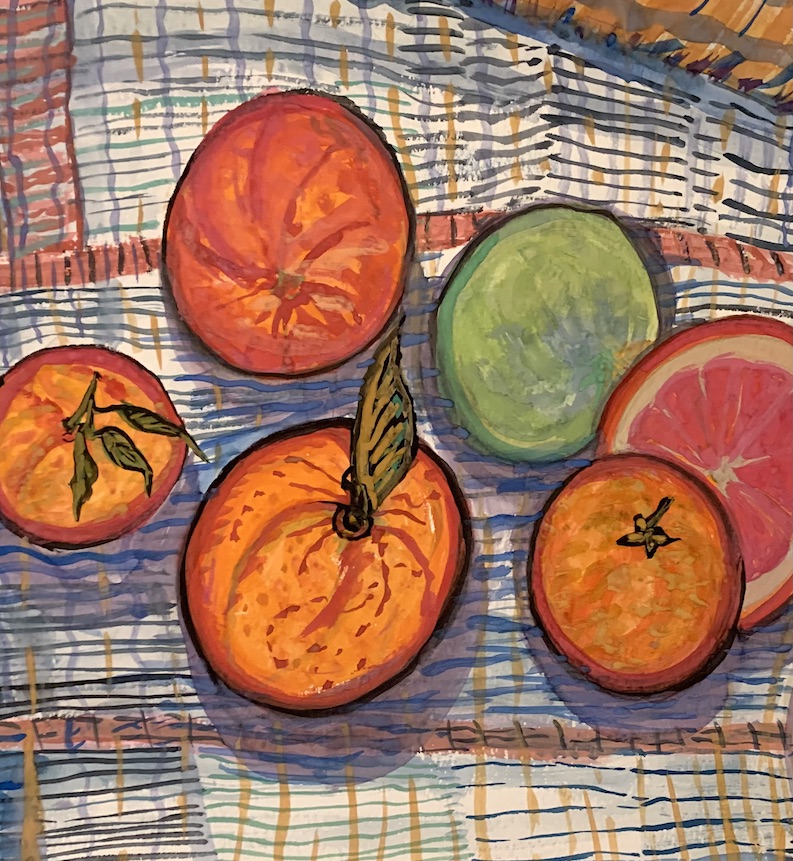
Painting by Elaine Brown Folgar
From Tom Dooley, Managing/Fiction
Here at the beginning of Eclectica's 29th year and my soon-to-be 55th, there's a palpable feeling of uncertainty in the air. I offer this issue as one palliative measure. May you connect with these fine authors, find community of spirit and intellect, and be fortified against the trials to come.
This issue is a bountiful one. Congratulations to Spotlight Author Theresa Buchta, whose timely essay, "How to Organize a Union," confirms history doesn't just happen but is made. Congrats also to R. Nemo Hill for being named our runner-up for poetry, and shout out to fiction runner-up Gary Moshimer, whose short story "Arnold's" marks his seventh appearance in Eclectica and second Spotlight recognition.
Many thanks to Elaine Brown Folgar for jazzing things up with her vibrant paintings and drawings. Props to Christine Potter for blowing the doors off the poetry section. Much appreciation to Ann Skea for literally decades of reviews, and to Thomas Hubschman for continuing to anchor the Salon (and he's got a short story in this issue, too!). And I can't stress enough how fortunate I feel to be working with Marko Fong. Anyone who has read his essays or communicated him in any way knows he possesses that rarest of intellects, driven by what I would paradoxically describe as dogmatic curiosity or cautious subversiveness. I don't think I'm exaggerating in saying his very presence raises our game.
As always, our former contributors have been doing all kinds of great things. To mention a few:
•Sagging Meniscus Press will soon be publishing Kat Meads' While Visiting Babette, described as "a giddy, lyrical, wide-eyed, Woolf-inflected dream of adolescence and the age's urge to both commemorate and destroy itself."
• Ron Currie has a new novel coming out, The Savage, Noble Death of Babs Dionne, which Publishers Weekly calls "a major achievement."
• All This Can Be True is Jen Michalski's forthcoming novel, a "profoundly moving story about the tangled web of intimate relationships, the paradoxical power of secrets to both destroy and unite a family, and the hard-earned rewards of stepping out of the darkness and into the light of one's own truth." It's due out this coming June.
• Marc Frazier's book of poetry, If It Comes to That, called "a design for living," won a silver medal at the Florida Writers Royal Palm Literary Awards.
• Hulu's Interior Chinatown, based on Charles Yu's National Book Award-winning novel of the same name, is looking to be another big television hit for him. "A biting satire of the Asian stereotypes," the show has been called "funny, genre-smart and clever" and visually inventive, and praised for fleshing out its supporting characters even more than the source material.
• Laird Barron has a collection of horror stories out called Not a Speck of Light, where he "returns to the dark and dreadful with his fifth horror collection," weaving "sixteen weird tales into a mosaic of the bloody and the macabre."
• Meg Pokrass recently published a collection of new and selected stories called First Law of Holes, about which the venerable Bob Hicok blurbed, "The people in these stories need Meg Pokrass. Their lives are tough but her imagination is the fire-lasso that can save them, save us."
The above is by no means an exhaustive list. For more information, check out our extended "family" Facebook group.
There it is, and there you have it. Happy New Year, and happy reading.
From Marko Fong, Nonfiction
The year 2024 ended with the passing of President Jimmy Carter, and now 2025 has started ominously with what appears to be at least one terrorist attack in New Orleans killing at least 15 people and a second, less deadly incident involving a Tesla Cybertruck in front of the Trump Hotel in Las Vegas. Both incidents involved electric trucks rented through Turo, an exotic car-share service, suggesting a possible connection between the two. In the shadow of this and the myriad other about-to-be terrifying events I haven't mentioned, putting together the nonfiction section for an online journal feels trivial or even pointless.
On the surface, this issue's pieces appear to have little to nothing in common. At least that's what I thought until I helped proof them recently and noticed how so many had something in common: a sort of passion pushing them forward.
Driving passion was certainly the case with Theresa Buchta's spotlight feature "How to Organize a Union," a compelling story disguised as a kind of list or recipe, which evoked Jamaica Kincaid's Girl and Tim O'Brien's The Things They Carried.
Laynee Wessel's "This Town Ain't Big Enough for the Two of Us" lays bare the intense feelings of a crush between two girls before either comes out to themselves.
Joe Bardin's "See You in a Hundred Years, My Dear" explores cryonics from the perspective of someone serious in his refusal to accept death for his loved ones or himself, at least for a hundred years, assuming all goes well. Given the last couple months, freezing my body and waiting to be revived in some cheerier time actually seems like a pretty sane idea.
Munkh Erdene, a young Mongolian, is passionate about ending corruption in his country. In that spirit, he shares the story of Damdin Sükhbaatar, who was either a heroic leader or the product of an early exercise in Russian fake news. The haunting resonances for America in 2025 may or may not be coincidence. Is passion the umami of nonfiction that works for me? I'm reminded that sharing one's passion through writing is never pointless.
In a moment where a bit more humor is surely welcome, we have three new humor pieces. Jeff Friedman's "Senior Pickleball" turns the search for a partner into a sort of serial killer saga. Timothy Laurence Marsh's "The Horrible Burden of the Human Condition" satirizes the saga of a masterpiece eluding completion. And Andrew Bertaina's "Good News" parodies a neurotic's attempt to post something on social media—or is it social media making us neurotic?
When a publication called Eclectica includes a section called "Miscellany," it evokes an M.C. Escher-like self-referential infinity. If you're old enough to remember, the last page of Life Magazine was also called "Miscellany." That said, I've never been sure how things wind up there. Still, it seems fitting Charles Sutphin's story of two lives joined by a shared name—his own—found its way.
From Christine Potter, Poetry
Back when I was teaching English and creative writing in the local high school, we always started our ninth graders with The Miracle Worker by William Gibson. That none-too-subtle Helen Keller play was the first thing the kids studied with us, and at first I didn't see why, but after a while I did. It's about the power of a single word: water. The power of a single word is the power of all words. I was a poet before I was a teacher; I should have known that.
And I started editing this poetry section before the US Presidential election—finished it afterwards. Like many Americans, I'm still reeling. But I also believe that if anything can get us back to a place of kindness and community in this country, it is poetry, especially poetry in small, independent magazines like this one. It's that power of a single word again, in the right place, in the right poem.
As I write this in late December, I'm thinking maybe the word we are looking for these days is love. You have to love something to write a poem about it.
So in this issue, we've got a whole lot of love for you. There's some wonderful light verse; we lead off with two good new poems from Gail White of Light Magazine. We've got a wonderful tribute by novelist and poet Rachel Dacus to her late mother called "Weathering It." And speaking of love, how about the brilliant monorhyme duet with Emily Dickinson by Charles Weld? "Duet With Emily in the Key of U" had my jaw on the desk the first time I read it. It is a daring feat!
If you like daring feats, cast your eyes on Robert Schechter's Villon translation. Yes, it's"Ballade of the Ladies of Time Past," but Schechter's jaunty version is just called "Ballade of the Ladies." It's a good poem for January, and I love his fearless translation. Schechter, also known for his poetry for children, also contributed a pair of poems on the monkey-with-a-typewriter theme, lest we take him too seriously.
Other standouts are R. Nemo Hill's sweetly nostalgic poems and Connie Wasem Scott's "Please Talk Some Sense Into Her," a calendar-girl kind of poem with its imagination on fire.
Big news from the Word Challenge department: we have two great poems from Judy Kaber containing this issue's words. That's 'cause she used our last issue's words to write a poem she entered in a contest—and won first prize! The lesson here is clearly that everyone should take the Eclectica Magazine Word Poem Challenge. Next issue's words are soggy, adagio, marble, and overwhelmed.
We've got poems about family love and parenting, poems about bad and good decisions made because of love, poems of struggling and solid families, free verse, formal verse, and prose poems. What a good group of poems and poets! It's an honor to be able to present these to you, and I hope you'll find reading this section as inspiring as it was putting it together. Savor the words—and see you all next issue.